
WorldRiskReport 2025: Billions threatened by flooding
Show more
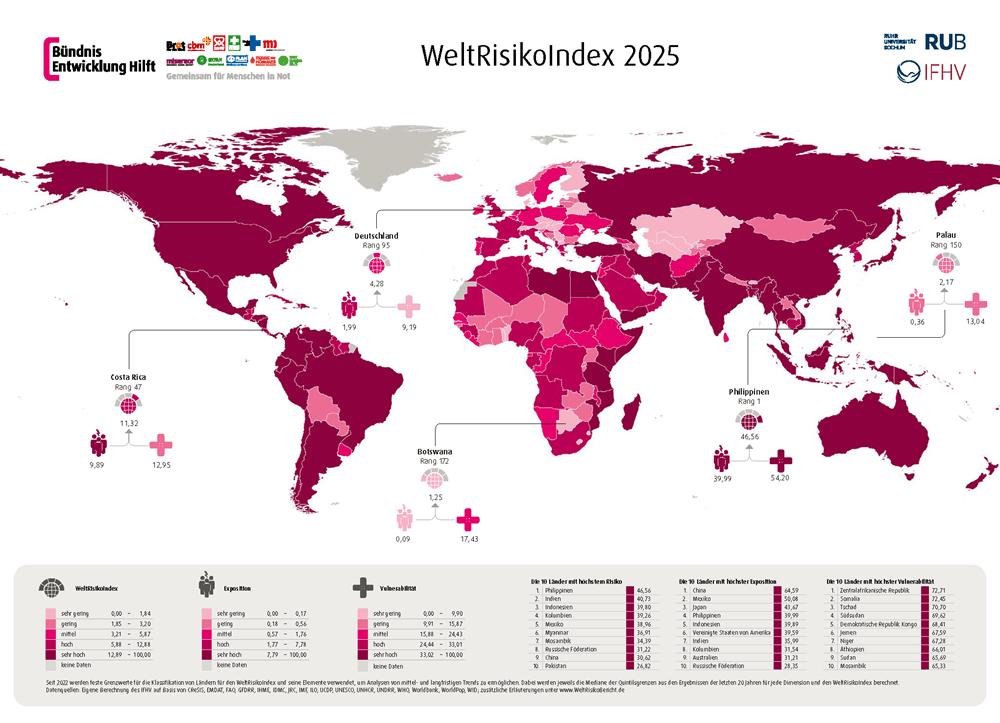
Berlin/Bochum, 24th September 2025. The World Risk Report 2025, published today and compiled annually by the Bündnis Entwicklung Hilft and the Institute for International Law of Peace and Humanitarian Law (IFHV) at Ruhr University Bochum, focuses this year on the topic of flooding. Floods are among the most frequent and devastating natural hazards worldwide. Between 2000 and 2019, more than 1.6 billion people were affected, with economic damage amounting to over 650 billion US dollars. Analyses show that climate change, urbanisation and inadequate land use are driving the risk. Countries with low incomes and weak infrastructures are particularly affected. 89 percent of people affected by flooding worldwide live in low- and middle-income countries.
Holistic prevention
The report analyses flood prevention from four perspectives:
- Political: Stronger local governance structures and coordinated prevention strategies
- Technological: Early warning systems, AI and satellite data
- Social: Integration of traditional knowledge and community-based approaches
- Ecological: Nature-based solutions such as mangroves, wetlands or river restoration
Global analysis of flood risk
For the first time, the report includes a global analysis of flood risk, including its own world map, which shows Germany as being at high risk of flooding. The flood disaster in the Ahr Valley in 2021 made it clear that a lack of preparation, weak warning systems and institutional fragmentation can be fatal even in a highly developed country.
For the Philippines, flood exposure was also calculated at the provincial level for the first time. Local hotspots such as the lowland regions of Cagayan and Pampanga underscore the importance of local analyses for effective prevention.
Philippines once again tops risk rankings
The current World Risk Index assesses the disaster risk of all 193 member states of the United Nations. In 2025, the global risk hotspots will again be in Asia and Latin America, while Africa will have the highest vulnerability.
As in the previous year, Germany ranks in the global midfield (95th place).
Show more
Contact